Approx 5-min read
Causes, warning signs, treatment and a practical route back to running
Your knee feels fine when you walk, but a few miles into a run a dull ache develops around the kneecap. Stairs become uncomfortable, squatting irritates it and the knee feels stiff when you stand after sitting.
This is a common pattern with runner’s knee — more accurately called patellofemoral pain or PFPS. The encouraging news is that it rarely means your knee is “worn out”. In many cases, the right combination of load management, progressive strengthening and hands-on treatment can settle symptoms and help you run confidently again.
What is runner’s knee?
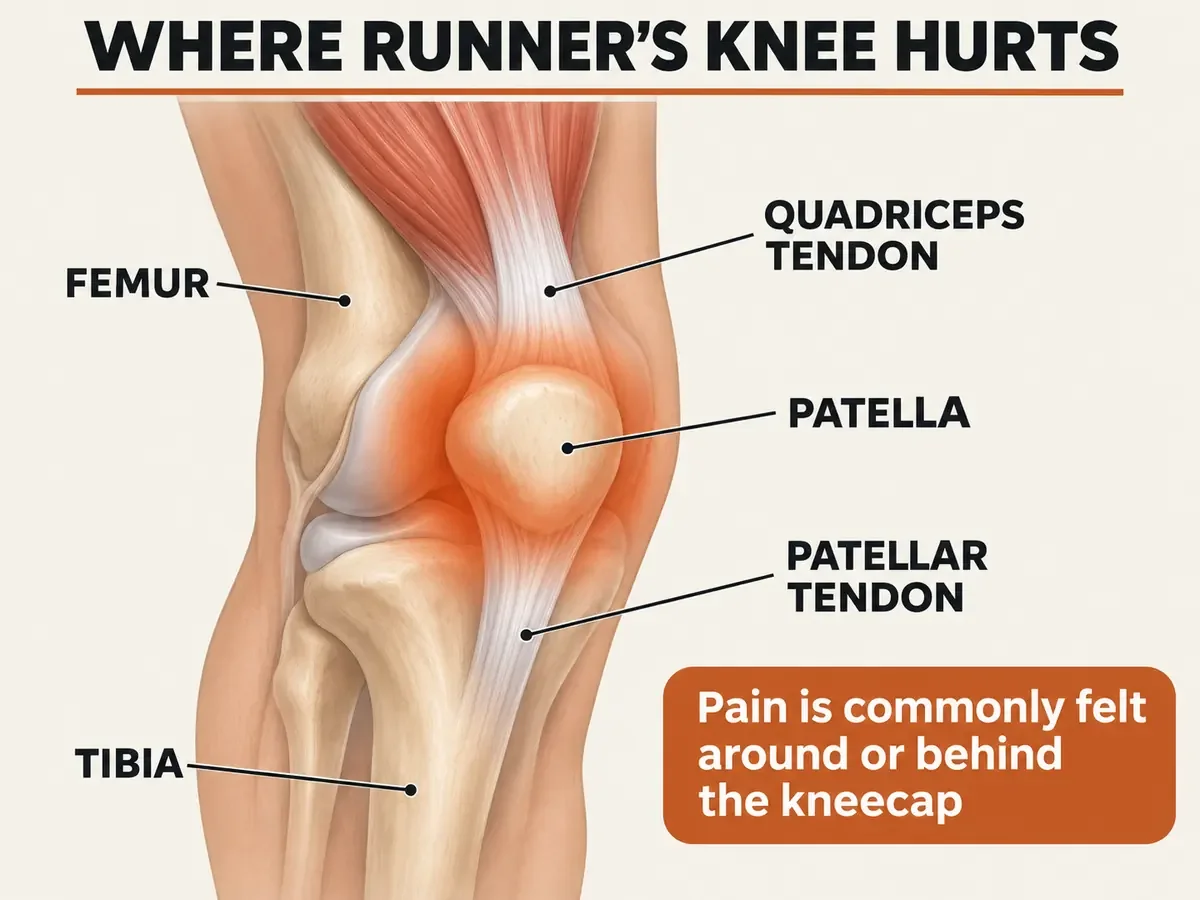
Runner’s knee describes pain around or behind the kneecap. It is usually aggravated by activities that load a bent knee, including running, descending stairs, squatting, lunging or sitting for a long time.
The pain may feel dull, sharp or difficult to pinpoint. Clicking and grinding can also occur, but noise alone does not necessarily mean the joint is being damaged.
“Runner’s knee” is a broad label rather than a precise diagnosis. Patellar tendinopathy, meniscus irritation and other knee problems can produce different symptoms, which is why assessment matters.
Why does my knee hurt when running?
Runner’s knee rarely has one simple cause. It often develops when the demand placed on the knee increases faster than its current ability to tolerate it.
Common triggers include:
A sudden increase in mileage or running frequency
Adding hills, speed sessions or more downhill running
Combining running with heavy gym, jumping or HYROX training
Returning too quickly after a break or injury
Inadequate recovery between demanding sessions
A change in footwear or running surface
The problem is not always running itself. It is often the amount, intensity and type of load — and whether your body has been prepared for it.
This is why blindly resting until the pain disappears can be frustrating: nothing has necessarily been done to improve the knee’s capacity.
For more on managing increases in training, read Does the 10% Running Rule Prevent Injury?.
It is not always just the knee
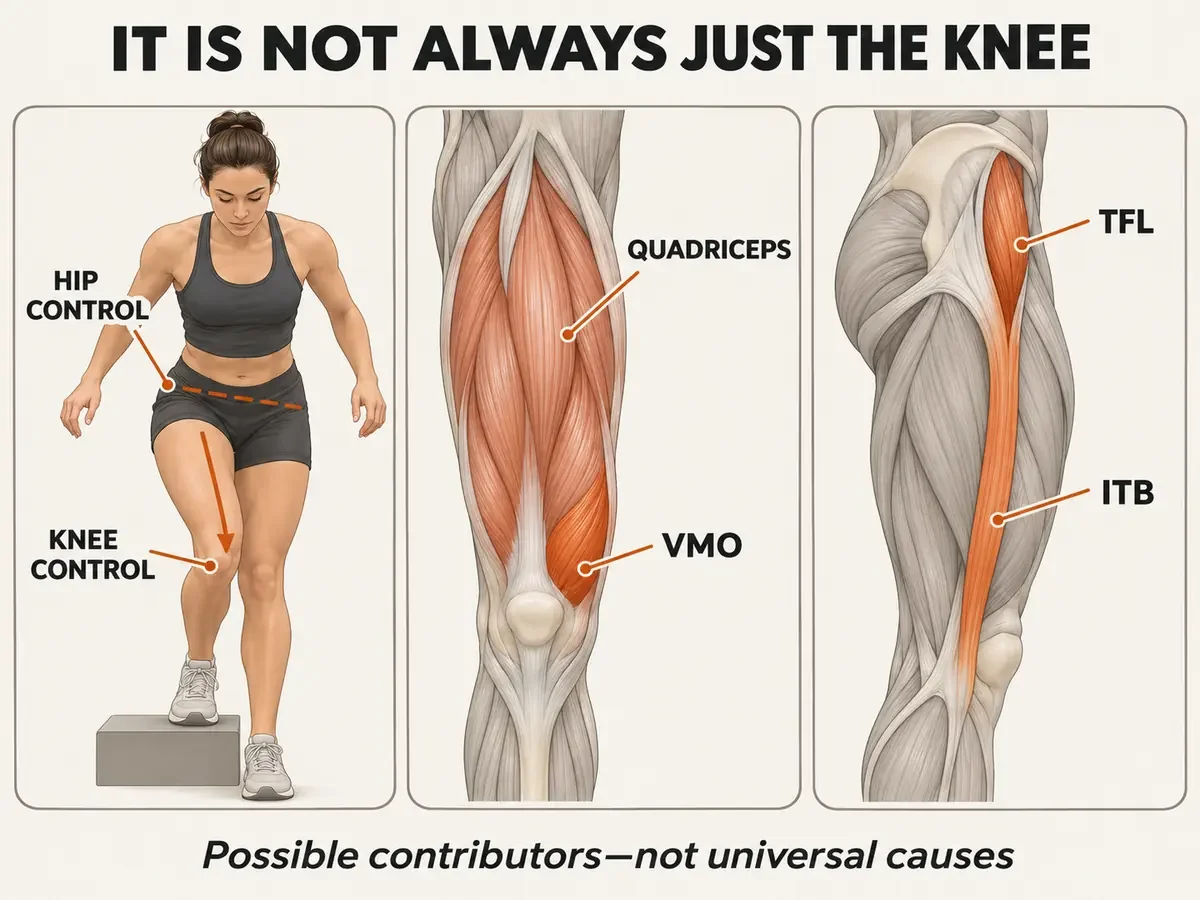
Your kneecap works within a larger movement system. The strength and control available through your hip, thigh, foot and ankle can all influence how the knee manages each stride.
Reduced hip control may allow the thigh and knee to drift inwards during single-leg loading. Limited quadriceps strength — particularly poor control while landing, descending stairs or running downhill — can increase the demand around the kneecap.
The vastus medialis oblique (VMO), on the inside of the thigh, contributes to controlling the patella as part of the wider quadriceps group. Tenderness or increased tone through the outer quadriceps, tensor fasciae latae (TFL) and tissues around the iliotibial band (ITB) may also form part of the picture.
However, runner’s knee is rarely explained by one “weak” muscle or one “tight” structure. These findings need to be considered alongside your training load, symptoms and how you move.
Can you continue running?
Not every case requires complete rest. If the pain is mild, remains stable and settles by the following morning, you may be able to continue with shorter, easier runs while reducing hills, speed or overall volume.
If the pain intensifies during the run, changes your stride or remains noticeably worse the next day, the current load is too high. Continuing to push through it is unlikely to build useful tolerance.
What treatment helps runner’s knee?
The strongest approach combines education with progressive knee and hip strengthening. Depending on the runner, treatment may also include temporary training changes, running or movement retraining, taping, footwear guidance and hands-on therapy.
Sports massage and remedial soft tissue therapy can play a valuable supporting role. Reducing discomfort and excessive tone through the quadriceps, gluteal muscles, TFL, lateral thigh and calf can improve movement tolerance and make rehabilitation exercises or running feel more manageable.
Hands-on treatment is most useful when combined with a plan that gradually rebuilds the knee’s capacity.
You can also read more about sports massage for runners before and after a race.
How we treat runner’s knee at Kinesis Performance
At Kinesis Performance, treatment starts with understanding when the pain appears, what your training has looked like and what has recently changed.
Assessment may include:
Squat, step-down and single-leg control
Hip stability and quadriceps capacity
Ankle and foot movement
Areas of sensitivity or excessive muscular tone
Running shoes, surfaces and weekly training load
Treatment is then tailored to what we find. It may combine sports massage and remedial soft tissue techniques with practical load guidance and a progressive strength programme.
The aim is not simply to make the knee feel better for a day; it is to improve how well it handles the demands of running.
If your presentation suggests something other than patellofemoral pain, or requires further investigation, you will be advised appropriately.
Three useful steps to start now
Reduce the aggravating demand — not all movement. Temporarily shorten runs or remove hills and faster sessions.
Build strength progressively. Controlled squats, step-downs and split squats can help, provided the exercise and load suit your current symptoms.
Check the next morning. If pain or stiffness is clearly worse, reduce the previous session rather than repeating it unchanged.
When should knee pain be assessed?
Seek appropriate assessment if your knee is swollen, locks, repeatedly gives way, cannot bear weight, followed a significant twist or impact, or is becoming progressively worse.
Persistent pain that keeps returning whenever you run also deserves a closer look.
Knee pain does not automatically mean you must stop running indefinitely. It does mean the cause, training load and your current physical capacity should be understood.
If knee pain is affecting your running, book an Initial Assessment & Treatment at Kinesis Performance in Welwyn Garden City.
We will assess the wider picture, treat the contributing areas and build a practical plan to help you return to running with confidence.
References
Neal BS, Lack SD, Bartholomew C, Morrissey D. Best practice guide for patellofemoral pain based on synthesis of a systematic review, the patient voice and expert clinical reasoning. British Journal of Sports Medicine. 2024;58(24):1486–1495.
Willy RW, Hoglund LT, Barton CJ, et al. Patellofemoral Pain. Journal of Orthopaedic & Sports Physical Therapy. 2019;49(9)–CPG95.